Mold Manufacturing Services
DTG provides precision mold manufacturing for custom plastic and metal parts, helping customers achieve durable tooling, accurate dimensions, stable production, and cost-effective manufacturing from prototype to mass production.
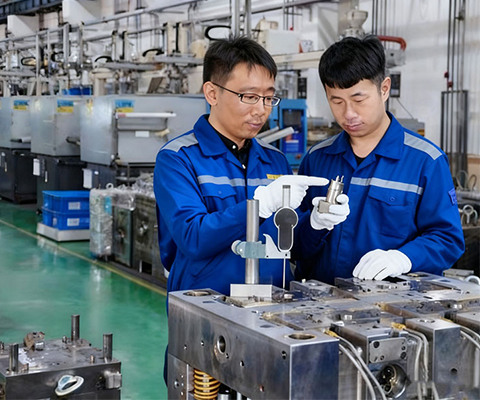
Your One-Stop Partner for Custom Mold Manufacturing
As a trading company plus factory model, DTG combines responsive international project communication with hands-on manufacturing capability. We support mold design, tooling, prototyping, injection molding, assembly, and export delivery.
One-Stop Solution
From Design → Prototype → Mold → Production → Assembly, DTG supports the complete manufacturing process to reduce communication cost and project risk.
Engineering Support
Our team provides DFM review, tooling structure suggestions, gate and cooling recommendations, and manufacturability optimization before mold production.
Precision Tooling
DTG focuses on accurate machining, reliable mold fitting, stable mold trials, and strict quality inspection for custom molds and precision plastic parts.
Cost Optimization
We help customers select suitable mold steel, mold structure, cavity number, runner system, and production process based on volume and target cost.
Flexible Production
DTG supports prototype tooling, bridge tooling, low-volume production, and mass production molds for different stages of product development.
Export-Oriented Service
We understand overseas buyers’ requirements for documentation, communication, mold standards, sample approval, packaging, and delivery coordination.
Custom Mold Manufacturing Capability for Global Projects
DTG manufactures a wide range of custom molds, from standard injection molds to complex precision molds, hot runner molds, overmolding molds, thin-wall molds, and export molds.
| Supported Mold Types | Plastic injection molds, overmolding molds, insert molds, hot runner molds, multi-shot molds, thin-wall molds, precision molds, and large-size molds. |
|---|---|
| Supported Services | Mold design, DFM analysis, mold manufacturing, mold trial, sample inspection, mold modification, injection molding, and assembly. |
| Mold Standards | DME, HASCO, MISUMI, LKM, and customer-specified export mold standards. |
| Common Steel Options | P20, 718H, NAK80, S136, H13, 2344, and other mold steels based on resin, volume, and surface requirements. |
| Production Support | Prototype runs, low-volume production, bridge tooling, and mass production support. |
Injection Mold Types We Manufacture
DTG can manufacture common and advanced mold structures for different product complexity, production volumes, material requirements, and functional applications.
Common Mold Types by Technical Structure
Two-Plate Mold
DTG manufactures two-plate molds for simple to medium-complexity plastic parts requiring stable production, easy maintenance, and cost-effective tooling solutions. These molds are widely used for consumer products, electronic accessories, and industrial plastic components.
Three-Plate Mold
DTG provides three-plate mold solutions for products requiring automatic gate separation, improved gate positioning, and more flexible part design. This mold structure is suitable for precision plastic parts with higher appearance and dimensional requirements.
Hot Runner Mold
DTG designs and manufactures hot runner molds to improve production efficiency, reduce material waste, and shorten cycle times. Hot runner systems are ideal for high-volume manufacturing projects that demand consistent quality and lower production costs.
Slider and Lifter Mold
DTG develops slider and lifter molds for complex plastic parts with undercuts, side holes, and intricate structures. Our engineering team ensures smooth mold action, stable production performance, and long mold life for demanding applications.
Stack Mold
DTG offers stack mold solutions for high-volume production requiring increased output without expanding machine tonnage. Stack molds help customers improve productivity and reduce per-part manufacturing costs.
Multi-Shot / Multi-Material Mold
DTG manufactures multi-shot and multi-material molds for products combining different colors, materials, or functions in a single molding process. These solutions are widely used for consumer electronics, automotive components, and ergonomic product designs.
Insert Molding & Overmolding
DTG provides insert molding and overmolding services for combining plastic with metal or other materials to improve strength, functionality, and product appearance. Our solutions support durable and high-performance components for industrial and electronic applications.
Gas Assisted Injection Mold
DTG develops gas assisted injection molds for lightweight plastic parts requiring reduced sink marks, improved structural strength, and optimized material usage. This technology is suitable for large plastic components and complex hollow structures.
Injection Compression Mold
DTG offers injection compression molding solutions for products requiring high surface quality, precise dimensions, and reduced internal stress. This process is commonly used for optical components, thin-wall products, and precision plastic parts.
Thin Wall Injection Mold
DTG manufactures thin wall injection molds for lightweight plastic products requiring fast cycle times and efficient mass production. Our engineering team focuses on precise tooling, balanced filling, and stable molding performance.
Unscrewing Mold
DTG designs unscrewing molds for threaded plastic parts requiring automatic demolding without damaging internal or external threads. These molds are widely used for caps, connectors, medical components, and industrial fittings.
Microcellular Foam Mold
DTG provides microcellular foam molding solutions for lightweight plastic products with reduced material consumption and improved dimensional stability. This technology is suitable for automotive, industrial, and consumer applications requiring weight reduction and structural performance.
Our Mold Manufacturing Process
DTG follows a structured mold manufacturing process from design review to final delivery, helping customers reduce tooling risks, improve mold performance, and ensure production readiness.
Product & Mold Design Review
The mold manufacturing process starts with a detailed product and mold feasibility review. DTG evaluates part structure, wall thickness, undercuts, draft angles, sharp corners, and potential molding risks to ensure the product is suitable for stable production. Our engineering team also determines the optimal mold structure, including parting line layout, gate design, ejection method, and cooling strategy.
3D Mold Structure Design
Based on the review results, DTG creates a complete 3D mold design using professional engineering software. This includes cavity and core design, mold base selection, slider and lifter mechanisms, cooling channels, ejection systems, and motion interference analysis.
2D Engineering Drawings
After completing the 3D design, DTG generates detailed 2D engineering drawings for production. These drawings include dimensional tolerances, surface finish requirements, heat treatment specifications, material grades, and assembly details.
Material Preparation & Rough Machining
DTG selects suitable mold steel and standard mold bases according to project requirements. During rough machining, steel blocks are cut, milled, drilled, and prepared to basic dimensions while leaving machining allowance for later finishing processes.
Heat Treatment
For molds requiring high hardness and wear resistance, DTG performs heat treatment processes such as quenching, tempering, nitriding, or vacuum heat treatment. Heat treatment improves mold durability, dimensional stability, and production lifespan.
CNC Precision Machining
DTG uses high-precision CNC machining centers to manufacture mold cavities, cores, parting surfaces, and other critical mold components. For complex geometries and deep cavities, high-speed machining and advanced tooling strategies are applied to achieve excellent dimensional control and surface finish.
EDM & Wire Cutting
For sharp corners, narrow slots, deep ribs, or complex features that cannot be machined directly by CNC, DTG applies EDM and wire cutting technologies. These processes allow precise machining of difficult mold structures and complex tooling details.
Grinding Process
Grinding is used to achieve superior flatness, precision fitting, and surface smoothness on critical mold components. DTG performs precision grinding on guide surfaces, inserts, mold plates, sliders, and fitting areas.
Mold Assembly & Fitting
All finished mold components are assembled and carefully fitted by experienced mold technicians. DTG performs detailed fitting and adjustment of parting surfaces, sliders, lifters, ejector systems, and moving components to ensure smooth mold operation and proper sealing.
Mold Polishing
Depending on product appearance requirements, DTG performs mold polishing to achieve the required surface texture or mirror finish. Polishing improves product appearance, reduces demolding resistance, and supports high-quality cosmetic surfaces.
Mold Trial & Sample Inspection
After assembly, the mold is tested on injection molding machines under controlled production conditions. DTG inspects trial samples for dimensional accuracy, surface quality, assembly fit, and functional performance. If issues are detected, the mold is optimized and retested until samples meet customer requirements.
Surface Texture & Final Delivery
After sample approval, DTG can apply surface textures or etching finishes according to customer specifications. Final mold cleaning, inspection, mold marking, documentation, and packaging are completed before shipment.
Common Mold Steel Materials
Mold steel selection affects mold cost, machining performance, polishing quality, corrosion resistance, wear resistance, and mold lifespan. DTG recommends suitable mold materials based on product structure, resin type, production volume, surface requirements, and budget.
| Material | Key Features | Typical Applications | Typical Mold Life |
|---|---|---|---|
| P20 Steel | Pre-hardened mold steel with good machinability, moderate wear resistance, and cost-effective performance for general molds. | ABS, PP, PE, PS, PC parts, consumer products, home appliance parts, automotive interior parts, and general plastic products. | Approx. 100,000–300,000 shots, depending on cavity number, resin, usage, and maintenance. |
| 718H Steel | Improved pre-hardened mold steel with better uniformity, toughness, and polishing performance than standard P20. | Precision electronic parts, automotive functional parts, appliance panels, PC/ABS, POM, PA, PBT, and transparent plastic products. | Approx. 300,000–500,000 shots. |
| NAK80 Steel | Pre-hardened mirror-polishing mold steel with high hardness, excellent polishability, and good dimensional stability without additional heat treatment. | Optical parts, light guides, transparent parts, cosmetic packaging, high-gloss automotive trim, and premium appearance parts. | Approx. 500,000–1,000,000 shots. |
| H13 Steel | Hot-work mold steel with excellent heat resistance, toughness, and thermal fatigue resistance for high-temperature and high-stress applications. | High-temperature engineering plastics such as PEEK, PEI, LCP, PPS, glass fiber reinforced materials, hot runner components, and durable engineering parts. | Suitable for long-life tooling, including 1,000,000+ shots under appropriate conditions. |
| S136 Steel | Stainless mold steel with excellent corrosion resistance and high polishing capability for clean, transparent, and corrosive plastic applications. | Medical parts, food packaging, transparent PC/PMMA products, PVC, flame-retardant materials, optical lenses, cosmetic packaging, and cleanroom-related products. | Approx. 500,000–1,000,000+ shots, especially strong in corrosive environments. |
| 2344 Steel | Chromium-molybdenum-vanadium hot-work steel similar to H13, with strong thermal fatigue resistance and high-temperature performance. | High-temperature engineering plastics, PA66+GF, PBT+GF, automotive parts, electronics housings, thin-wall deep-cavity molds, and long-life production tools. | Suitable for 1,000,000+ shots with proper maintenance. |
Mold Tolerance & Quality Assurance
DTG controls mold quality throughout design, material selection, machining, assembly, trial production, and final delivery. Our goal is to ensure every mold is accurate, durable, easy to maintain, and ready for stable production.
Tolerance Control
For precision mold components, tolerances are controlled according to part structure, material behavior, mold steel, machining method, and customer drawing requirements. Critical dimensions can be controlled tightly when project requirements demand higher precision.
- Parting surface accuracy control
- Cavity and core dimensional verification
- Insert and slider fitting inspection
- Gate, runner, cooling, and ejection system checks
- Sample dimensional measurement after mold trial
Quality Control Process
- Design stage: Mold structure review, DFM analysis, interference check, and manufacturability confirmation.
- Material stage: Suitable mold steel selection and material quality control.
- Machining stage: CNC, EDM, wire cutting, grinding, and process inspection.
- Assembly stage: Mold fitting, motion check, ejection check, cooling check, and sealing verification.
- Trial stage: Sample inspection, defect analysis, mold correction, and final approval.
- Maintenance support: Cleaning, lubrication, storage protection, and mold life extension recommendations.
DFM Review
Wall thickness, draft angle, undercuts, gate location, sink mark risk, and cooling feasibility.
Machining Inspection
Key mold components are checked during CNC, EDM, wire cutting, grinding, and fitting.
Trial Sample Check
Samples are inspected for dimensions, appearance, assembly fit, warpage, sink marks, flash, and function.
Final Documentation
DTG can provide mold trial reports, sample inspection records, mold operation notes, and final drawings as required.
Tooling Life Based on Production Needs
Different projects require different tooling strategies. DTG helps customers balance mold cost, lead time, production volume, resin type, and expected mold life.
| Tooling Type | Typical Use | Estimated Mold Life | Best For |
|---|---|---|---|
| Prototype Tooling | Fast validation and early product testing | Approx. 5,000–20,000 shots | Design verification, functional samples, and early-stage development |
| Bridge Tooling | Low-volume production before mass tooling | Approx. 20,000–100,000 shots | Market testing, pilot production, and pre-production launch |
| Production Mold | Stable long-term manufacturing | Approx. 300,000–1,000,000+ shots | Mass production, high-volume projects, and long-term supply programs |
Industries We Serve
DTG supports mold manufacturing and injection molding projects across multiple industries, helping procurement teams and engineers turn custom product designs into reliable production-ready parts.
Automotive
Lightweight, structural, interior, exterior, functional plastic parts, and hot runner tooling for cost-effective automotive production.
Medical & Healthcare
High-precision medical housings, diagnostic components, disposable parts, and clean production-compatible tooling.
Electronics & Electrical
Two-shot molding, precision connectors, electronic housings, insulation parts, and compact structural plastic components.
Packaging
Multi-cavity molds, hot runner systems, fast cycle molds, thin-wall packaging, lids, caps, closures, and containers.
New Energy / EV
Charging gun housings, battery frame parts, energy storage components, connectors, protective covers, and assembly-ready parts.
Consumer Goods & Sports
Surface decoration, texture finishing, high-gloss molding, overmolding, ergonomic parts, and durable consumer product components.
Aerospace
Lightweight structures, flame-retardant materials, high-performance polymers, aircraft interior parts, and engineered plastic components.
Industrial Machinery
Pump and valve components, housings, gears, fittings, metal replacement parts, and wear-resistant industrial plastic parts.
Optics & Lighting
LED lenses, optical covers, light guides, transparent parts, lighting housings, and high-clarity plastic components.
Agriculture & Horticulture
UV-resistant, weather-resistant, high-volume outdoor plastic parts for irrigation, gardening, and agricultural equipment.
Building & Construction
PVC-specific molds, pipe fitting systems, construction hardware, electrical installation parts, profiles, and covers.
Marine & Offshore
Corrosion-resistant, salt-spray-resistant, and weatherable plastic components for coastal and offshore environments.
Mold Manufacturing FAQs
Below are common questions from procurement managers, engineers, and product development teams when starting a custom mold manufacturing project.
What is mold manufacturing?
Mold manufacturing is the process of designing and producing precision tooling used to shape plastic, metal, or other materials into custom parts through processes such as injection molding, die casting, or other molding methods.
What information do you need for a mold quotation?
We usually need 2D drawings, 3D CAD files, material requirements, estimated annual volume, surface finish requirements, tolerance requirements, application information, and any special quality or testing standards.
Can DTG provide DFM analysis before mold making?
Yes. DTG can review draft angles, wall thickness, undercuts, gate location, parting line, ejection method, cooling feasibility, and possible molding risks before mold manufacturing begins.
How long does mold manufacturing take?
Lead time depends on mold size, complexity, steel material, surface finish, cavity number, and project requirements. Prototype tooling may take several weeks, while complex production molds usually require longer engineering and manufacturing time.
What mold steel should I choose?
Mold steel should be selected based on resin type, production volume, surface finish, corrosion risk, glass fiber content, and expected mold life. DTG can recommend P20, 718H, NAK80, S136, H13, 2344, or other suitable steels.
Can you manufacture hot runner molds?
Yes. DTG can design and manufacture hot runner molds for high-volume production projects that require reduced material waste, faster cycle times, and stable part quality.
Can you support insert molding and overmolding?
Yes. DTG supports insert molding and overmolding projects that combine plastic with metal inserts, rubber-like materials, or other components into one integrated part.
Do you support low-volume production?
Yes. DTG supports prototype molds, bridge tooling, low-volume production, and mass production depending on project stage, target quantity, and budget.
Can DTG export molds overseas?
Yes. DTG can manufacture export molds according to customer-specified standards and provide suitable mold packaging, documentation, and delivery coordination for overseas customers.
How do you ensure mold quality?
DTG controls mold quality through design review, material selection, machining inspection, mold fitting, trial sample inspection, mold correction, final approval, and documentation before delivery.
Need Custom Mold Manufacturing Support?
Send us your drawings, 3D files, samples, or project requirements. DTG will help evaluate manufacturability, recommend suitable tooling solutions, and provide a quotation for your custom mold project.
Request a Quote